


Qilin and Phoenix Pattern Four-Out-Head Chair
Qilin and Phoenix Pattern Four-Out-Head Chair
Qilin and Phoenix Pattern Four-Out-Head Chair
Width: 66cm, Depth: 49.5cm, Total Height: 108cm, Seat Height: 47.5cm
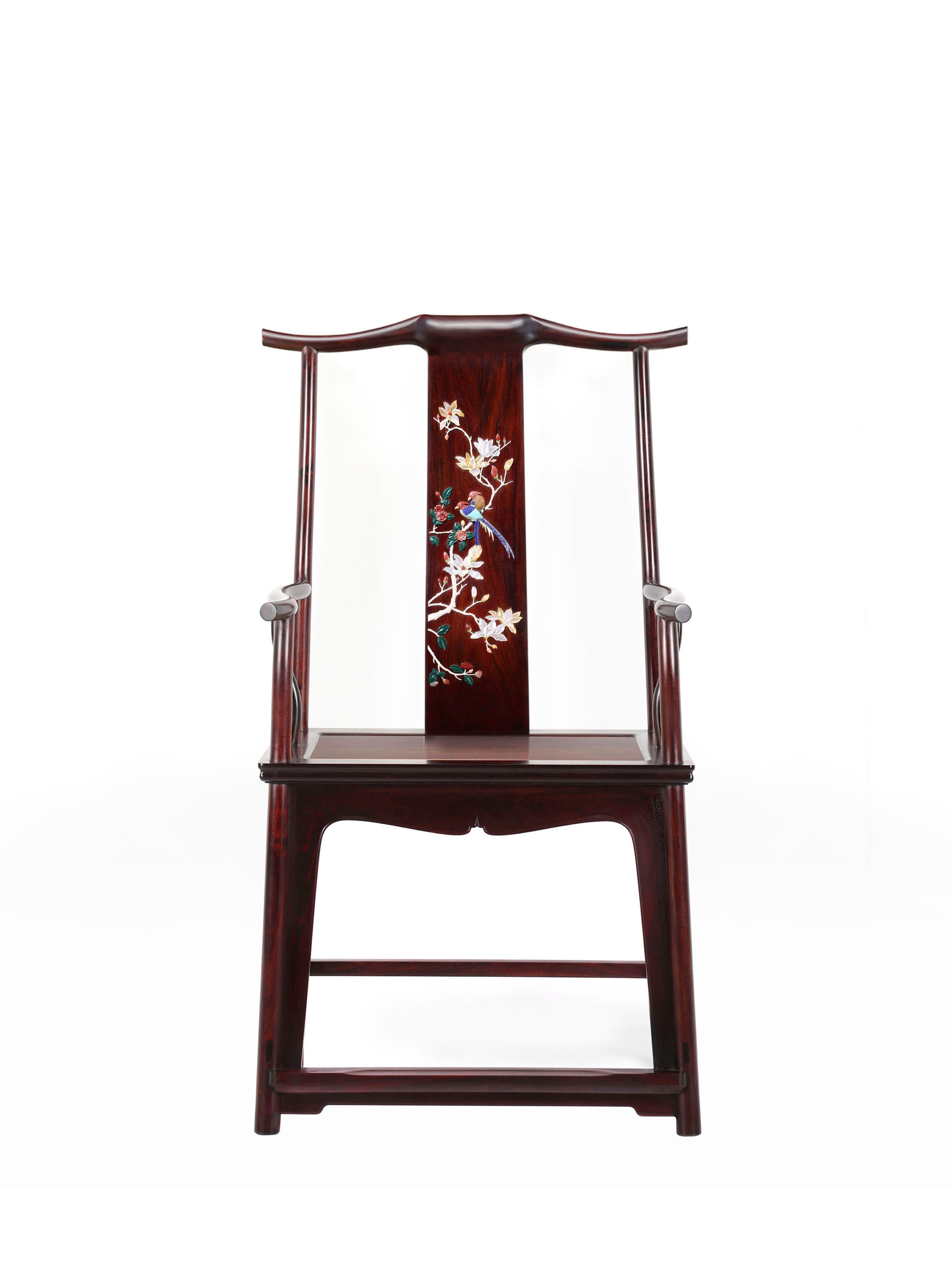
This official's hat chair is quite large, more than seven or eight centimeters wider than a regular chair. It is also made of very thin materials, with legs that are only about 2 centimeters long, achieving a spacious and elegant effect.
The crest rail has gentle undulations and is fitted with small horn teeth between it and the hind legs, which serve both a decorative and structural purpose.
The backrest is truly exquisite. It features a three-tiered design: a circular halo at the top and a rectangular, rounded-corner panel at the bottom, perfectly embodying the ancient Chinese philosophical concept of a round heaven and a square earth. The circular halo is decorated with a relief of a phoenix facing the sun, interspersed with peony ornaments. The rectangular, rounded-corner panel is decorated with a relief of a qilin (a mythical creature with a dragon's head), round eyes, wide-open beak, whiskers and hair gathered into a single, forward-pointing tuft, and fluttering antennae—characteristics of dragon motifs from the Wanli period. The qilin is covered in scales, with flame-like wings at the base of its legs, a raised tail, one front leg lifted, the other upright, and the hind leg half-bent, in a joyous leaping posture, conveying a sense of celebration. Beside the qilin are ancient, graceful pines, and in the distance, clouds support mountains. Above, auspicious clouds arch around the sun, while below are scattered treasures such as fire pearls, ruyi scepters, rhinoceros horns, and coral, depicting a scene of peace and prosperity. The footrest is very high, in a cusped shape, with scrolling grass patterns on both sides and a relief of a dragon looking back, seemingly floating in the air, exceptionally graceful. The carving technique is meticulous and elegant, with distinct layers and accurate depiction of objects. It is similar to the carving techniques used for small bamboo, wood, ivory, and horn pieces, and is a model of exquisite craftsmanship.
The armrests are gentle, with winding curves, and corner braces are attached between the straight gooseneck and the armrests. The connecting rods are in the shape of a vase, with bamboo joint patterns on the top. This type of vase-shaped bamboo joint connecting rod is a common structure in early antique furniture, and it is found in all furniture made of hardwoods such as huanghuali. The seat has a raised ridge in the middle along the ice-tray edge, with arc shapes on both sides, which is called "civil and military line" in the Jiangnan region, and is very vigorous. A narrow, plain, straight apron is installed at the front between the legs, with fine lines along the edges to emphasize the outline, making it feel more ethereal and beautiful. The other three sides are connected by aprons, and the legs are fitted with low stretchers at the front and back.
This official's hat chair has an excellent design and is a rare style, embodying the refined and upright spirit of Ming furniture. The decoration on the back panel is also in the rich and ornate style, which is elaborate but not chaotic. The beautiful, sculptural connecting rods echo it, adding a touch of nobility to the elegance.
For reference to the design: A pair from the Hong Kong Jiamutang Collection, sold at China Guardian 2012 Hong Kong Autumn Auction, "Guanhua – Masterpieces of Ming and Qing Classical Furniture and Garden Furnishings," LOT.0361. Also auctioned at Poly Auction on June 5, 2019. These four official hat chairs are identical in shape and size, with symmetrical patterns in pairs, indicating they were part of a set. The qilin and phoenix motifs were not used by ordinary people in ancient times; these chairs likely originated from the residence of an official.
Width: 66cm, Depth: 49.5cm, Total Height: 108cm, Seat Height: 47.5cm
This official's hat chair is quite large, more than seven or eight centimeters wider than a regular chair. It is also made of very thin materials, with legs that are only about 2 centimeters long, achieving a spacious and elegant effect.
The crest rail has gentle undulations and is fitted with small horn teeth between it and the hind legs, which serve both a decorative and structural purpose.
The backrest is truly exquisite. It features a three-tiered design: a circular halo at the top and a rectangular, rounded-corner panel at the bottom, perfectly embodying the ancient Chinese philosophical concept of a round heaven and a square earth. The circular halo is decorated with a relief of a phoenix facing the sun, interspersed with peony ornaments. The rectangular, rounded-corner panel is decorated with a relief of a qilin (a mythical creature with a dragon's head), round eyes, wide-open beak, whiskers and hair gathered into a single, forward-pointing tuft, and fluttering antennae—characteristics of dragon motifs from the Wanli period. The qilin is covered in scales, with flame-like wings at the base of its legs, a raised tail, one front leg lifted, the other upright, and the hind leg half-bent, in a joyous leaping posture, conveying a sense of celebration. Beside the qilin are ancient, graceful pines, and in the distance, clouds support mountains. Above, auspicious clouds arch around the sun, while below are scattered treasures such as fire pearls, ruyi scepters, rhinoceros horns, and coral, depicting a scene of peace and prosperity. The footrest is very high, in a cusped shape, with scrolling grass patterns on both sides and a relief of a dragon looking back, seemingly floating in the air, exceptionally graceful. The carving technique is meticulous and elegant, with distinct layers and accurate depiction of objects. It is similar to the carving techniques used for small bamboo, wood, ivory, and horn pieces, and is a model of exquisite craftsmanship.
The armrests are gentle, with winding curves, and corner braces are attached between the straight gooseneck and the armrests. The connecting rods are in the shape of a vase, with bamboo joint patterns on the top. This type of vase-shaped bamboo joint connecting rod is a common structure in early antique furniture, and it is found in all furniture made of hardwoods such as huanghuali. The seat has a raised ridge in the middle along the ice-tray edge, with arc shapes on both sides, which is called "civil and military line" in the Jiangnan region, and is very vigorous. A narrow, plain, straight apron is installed at the front between the legs, with fine lines along the edges to emphasize the outline, making it feel more ethereal and beautiful. The other three sides are connected by aprons, and the legs are fitted with low stretchers at the front and back.
This official's hat chair has an excellent design and is a rare style, embodying the refined and upright spirit of Ming furniture. The decoration on the back panel is also in the rich and ornate style, which is elaborate but not chaotic. The beautiful, sculptural connecting rods echo it, adding a touch of nobility to the elegance.
For reference to the design: A pair from the Hong Kong Jiamutang Collection, sold at China Guardian 2012 Hong Kong Autumn Auction, "Guanhua – Masterpieces of Ming and Qing Classical Furniture and Garden Furnishings," LOT.0361. Also auctioned at Poly Auction on June 5, 2019. These four official hat chairs are identical in shape and size, with symmetrical patterns in pairs, indicating they were part of a set. The qilin and phoenix motifs were not used by ordinary people in ancient times; these chairs likely originated from the residence of an official.
此官帽椅尺寸甚大,比一般的椅子宽七八厘米多,兼以用材甚细,腿足仅2厘米左右,取得了舒朗大方的效果。
搭脑柔和起伏,与后腿间装有小角牙,既有装饰效果,又有结构作用。
靠背板甚为精彩。三攒式,上方圆光,下方长方委角开光,恰合古人天圆地方之哲学概念。圆光内浮雕丹凤朝阳纹,杂以牡丹装饰。长方委角开光内浮雕麒麟纹,麒麟龙首,圆睛,两喙大张,须发凝为一束前冲,触角飘动,有万历时期龙纹特征。身披鳞甲,腿足根部有火焰翼,麈尾高扬,前腿一足提起,一足直立,后腿半曲,作欢腾跳跃状,甚为喜庆。麒麟旁有夭矫古松,远方云朵托着山峦,上方祥云拱日,下方散布火珠、如意、犀角、珊瑚等杂宝,一派海晏河清、盛世瑞象。亮脚牙板甚高,壸门式,两边卷草纹,上面浮雕回首螭龙,若浮空而行,夭矫非凡。图案雕刻手法细致大方,层次分明,物象准确,与竹木牙角小件雕刻手法相类,是大器细做的典范。
扶手柔和,曲线蜿蜒,直鹅脖与扶手间亦附角牙。联帮棍为宝瓶式,上为竹节纹。一般这种宝瓶竹节式联帮棍是早期高古家具上常见结构,凡黄花梨等硬木家具中所见者,无一不佳。座面冰盘沿中间突出一道棱线,两边为弧形状,为江南俗称的“文武线”,甚为遒劲。腿足间前方装窄素直券口牙板,边缘起细线强调轮廓,更觉空灵秀美。其他三面连以刀牙板,腿足下装前后低赶枨。
此官帽椅造型甚佳,且是罕见的样式,体现了明式家具洗练挺拔的风骨,靠背板的装饰又属秾华风格,繁而不乱,优美如雕塑般的联帮棍与之呼应,文雅之中又增贵气。
造型参见:香港嘉木堂尚一对,中国嘉德2012年香港秋季拍卖会“观华——明清古典家具及庭院陈设精品”LOT.0361。2019-06-05保利拍卖。4件官帽椅造型、尺寸相同,图案两两对称,显为4件成堂之物。麒麟纹、凤纹在古代非一般百姓所用,此椅应出自官宦府邸。
Frequently asked questions
Use the FAQ section to answer your customers' most frequent questions.
Order
Yes, we ship all over the world. Shipping costs will apply, and will be added at checkout. We run discounts and promotions all year, so stay tuned for exclusive deals.
It depends on where you are. Orders processed here will take 5-7 business days to arrive. Overseas deliveries can take anywhere from 7-16 days. Delivery details will be provided in your confirmation email.
You can contact us through our contact page! We will be happy to assist you.