Anji White Tea
ICH Inheritor Yan Ronghuo Handcrafted
Appreciation
Vintage:First Flush 2025 (Note: Due to the cold climate of its authentic origin, Anji White Tea does not have Pre-Qingming Tea.)
Grade: Top Rare
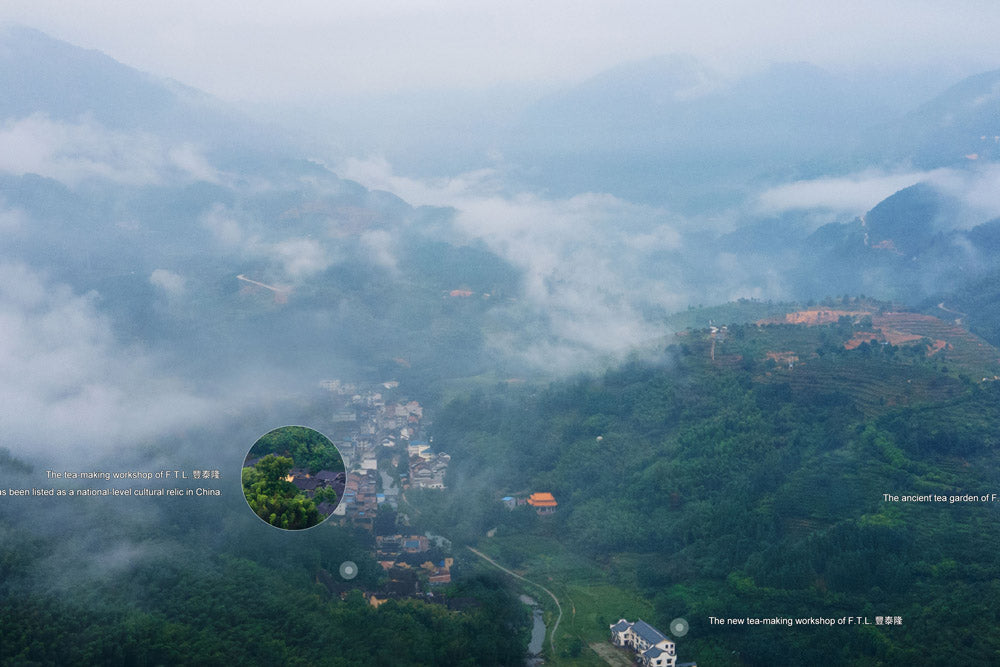
Producer: Yan Ronghuo, inheritor and founder of Anji White Tea making technique, an intangible cultural heritage. Homemade
Origin: Tianhuangping Town, Anji County, Zhejiang Province (core production area, altitude 800 meters) Yan Ronghuo's Tea Garden.
Variety: Baiye No. 1 tea tree variety. This variety is a low-temperature sensitive variant. Only when the temperature is 18-23℃ in spring do the new shoots and leaves turn jade white with emerald green veins. After the temperature exceeds 23℃, the leaves gradually turn green again. This unique whitening phenomenon results in an amino acid content of 5%-10.6% in the tea leaves (2-3 times that of ordinary green tea), while the tea polyphenol content is only 10%-14%, forming a biochemical basis of "high amino acid and low polyphenol," which creates its core characteristics of "fresh and refreshing without astringency, and long-lasting sweetness."
Process:
- Harvesting standards: The optimal picking standard is when the bud and the first leaf are just unfolding. Harvesting takes place on sunny mornings, using a "hand-picking" method to ensure the buds and leaves remain intact.
- Key processes: spreading, blanching, shaping , drying : initial drying → cooling → re-drying, final moisture content ≤6.5%.
- Quality control involves thirteen processing and screening steps, for top-tier tea. Substandard tea leaves are removed to ensure every leaf meets the requirements of "uniform appearance, pure aroma and fresh taste".
Appreciation:
- Dry tea appearance : Phoenix-shaped tea should have straight, prominent buds that are strong and uniform , resembling phoenix feathers; Dragon-shaped tea should be flat, straight, smooth, and uniform , resembling orchids. Top-grade tea has a bud ratio of over 90%, with no broken leaves or stems, and sparse but glossy white down.
- Color : Jade white and emerald green interspersed, with even whitening and translucency, and the buds and leaves have the same color.
- Texture : Dry and brittle, can be crushed into powder by hand, moisture content ≤6.5%.
Color Observation:
Scent:
- Cool Aroma : When you smell the dry tea, you can smell the fresh aroma of downy hairs (similar to the aroma of fresh rice) and tender chestnuts. The aroma is pure and high-pitched, without any grassy or burnt smell.
- Hot Aroma : The aroma is rich and layered after brewing. The first infusion is dominated by a downy fragrance, the second infusion gradually reveals a hint of orchid , and the aroma turns sweet after the third infusion . The fragrance lingers in the bottom of the cup and remains delicate even after the tea has cooled.
Taste: